
Civic Innovation Foundation: Digitising Public Consultation for Democratic Governance
Strengthening Participatory Law-Making through AI-Enabled Public Consultation




Watch the story in 60 seconds (AI-generated video; visuals are illustrative)
Case at a Glance
Civic Innovation Foundation (CIVIS) is a nonprofit organisation that enables structured, inclusive dialogue between governments and citizens on draft laws and policies. Through its technology-driven consultation platform, Civis supports governments to design, manage, and analyse public consultations at scale, ensuring citizen voices meaningfully inform democratic decision-making.
Despite public consultation being central to democratic governance, existing mechanisms relied on fragmented and manual processes such as emails and written submissions. Governments struggled to manage large volumes of unstructured feedback, ensure inclusive participation, and translate citizen inputs into actionable policy insights, limiting the effectiveness and credibility of consultations.
Civis developed an AI-enabled, end-to-end public consultation platform that supports governments across the consultation lifecycle. The platform enables structured citizen engagement, multi-channel and multilingual feedback collection, and advanced analysis of qualitative inputs, helping governments efficiently synthesise public feedback and translate it into clear, actionable policy insights.
Public consultation is a foundational pillar of democratic governance, yet the mechanisms used to engage citizens on draft laws and policies remained fragmented and difficult to scale. Governments often relied on emails, written submissions, and manual processes to gather public input, creating several systemic challenges:
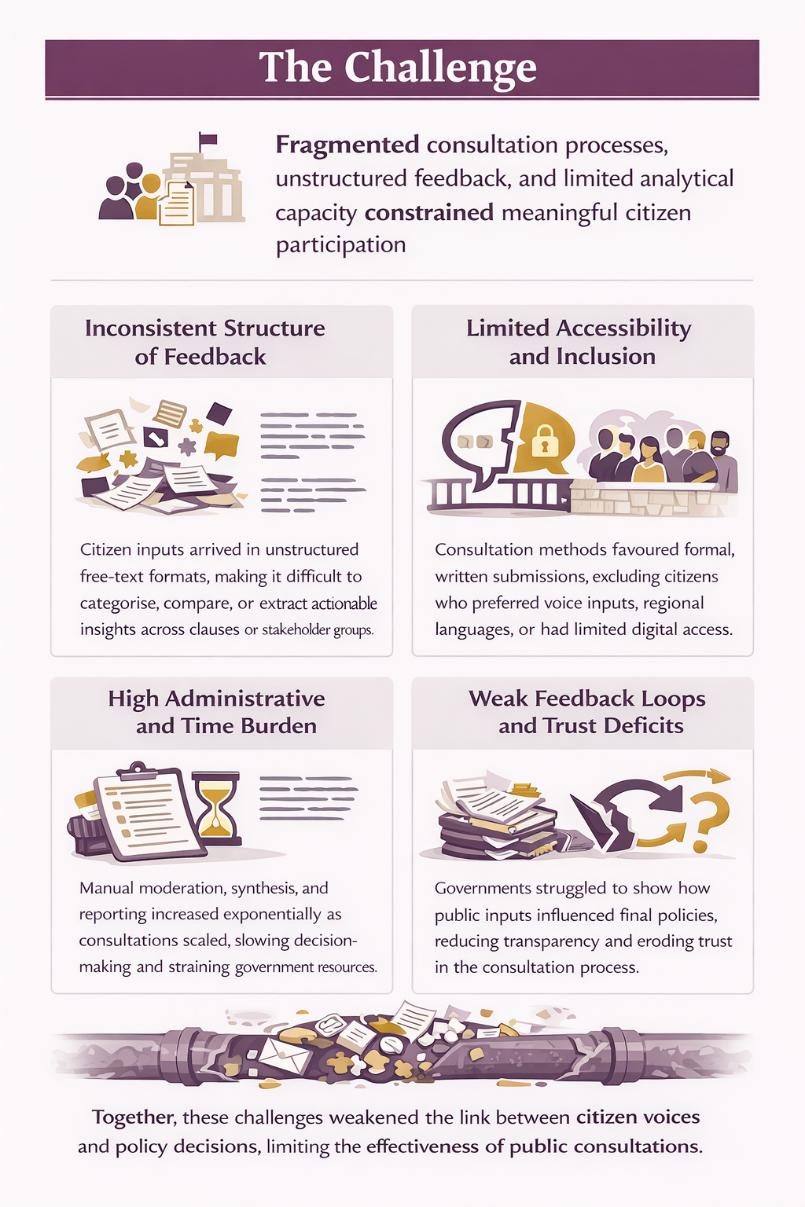
Together, these challenges limited the effectiveness of public consultations and weakened the link between citizen voices and policy decisions. Civis recognised the need for a solution that not only digitised consultations but fundamentally improved how governments listen, analyse, and respond to public input.
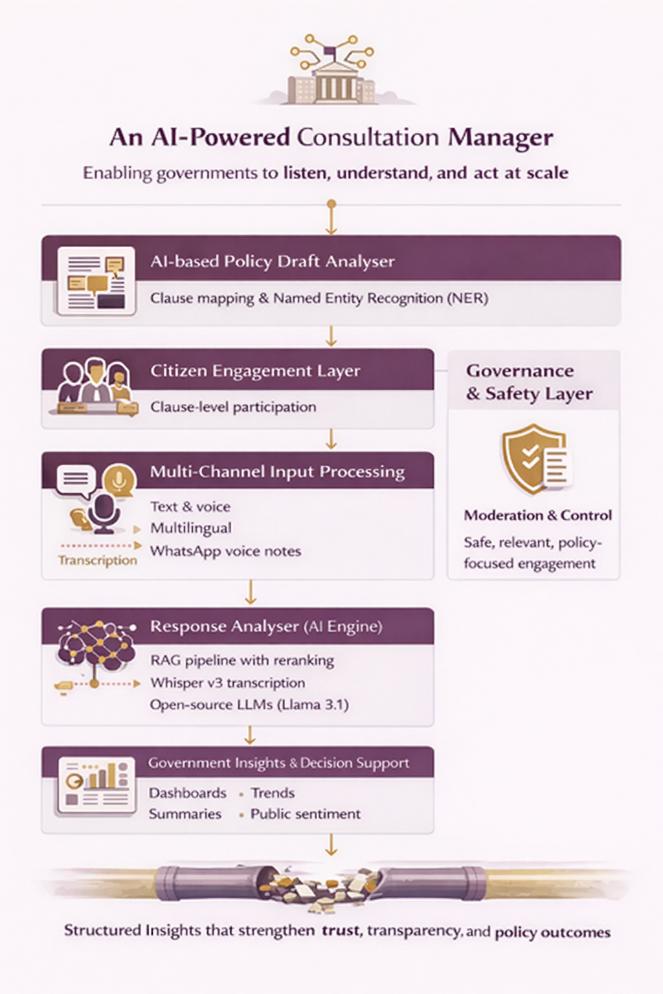
To address these systemic challenges, Civis built an AI-enabled Consultation Manager that supports the full lifecycle of public consultations. The platform integrates multiple AI components to process complex qualitative inputs while preserving the nuance of citizen voices.
At the core of the solution is an AI-based Policy Draft Analyser that uses Named Entity Recognition (NER) and clause-mapping engines to break down draft laws into understandable components. This allows citizens to engage with specific clauses rather than opaque legal documents.
The Response Analyser leverages a Retrieval-Augmented Generation (RAG) pipeline with reranking to synthesise large volumes of feedback across text and voice formats. Multilingual and multi-channel inputs including WhatsApp voice notes are transcribed using Whisper v3 and analysed using open-source large language models such as Llama 3.1 (distilled for reasoning and summarisation).
Moderation and control tools ensure safe, relevant, and policy-focused engagement, while dashboards and reports provide governments with structured insights, trends, and summaries of public sentiment.
Civis’ solution is modular, open-source, and designed for scalability, enabling deployment across varied policy contexts while remaining cost-efficient and adaptable to government needs.
Civis’ technology-enabled approach has strengthened both the reach and effectiveness of public consultations, translating citizen participation into measurable policy outcomes.
One notable example occurred in 2024, when proposed amendments to the Rights of Persons with Disabilities Rules were paused after Civis-facilitated feedback highlighted risks of rural exclusion, stigma, and implementation challenges. Citizen inputs directly reshaped the legislative process
Technology Stack
| Tools/ Techniques | Used For | What It Enabled | Category |
|---|---|---|---|
| Draft Analyser with NER (Named Entity Recognition) | Government consultations | Clause-level understanding, structured citizen engagement | Open Source |
| RAG Pipeline + Reranker | Citizen feedback analysis | Thematic synthesis, prioritisation of insights | Open Source |
| Whisper v3 | Voice-based consultations and speech-to-text analysis | Multilingual transcription and accessibility | Open Source |
| Llama 3.1 Distilled Model | Reasoning and summarisation | Efficient, scalable analysis of qualitative data | Open Source |
Key Project Learnings
Civis’ experience demonstrates how AI, when thoughtfully deployed, can strengthen democratic processes:
Voice-first, multilingual engagement ensured inclusion without compromising analytical rigour.
Open-source models and transparent workflows-built credibility with government partners.
Structured analysis and clear reporting closed the loop between citizen input and policy decisions.
Potential for Wider Adoption
| Sector | Adaptability of the Solution |
| Government Systems | Applicable across common law countries seeking scalable, transparent public consultation mechanisms. |
| Civil Society Organisations | CSOs can use modular components to engage stakeholders on policy, regulation, and reform initiatives. |
| Collaborative Projects | Multilateral and global programs suitable for large-scale, cross-country consultations requiring multilingual and qualitative analysis. |
See it in Action