
Strengthening Early TB Detection by Embedding AI into Government-Led Active Case Finding
Case at a Glance
Impact
.png "12,12,932")
12,12,932
beneficiaries screened using AI-enabled chest X-rays

9,804
TB cases confirmed, including 32% asymptomatic cases

62%
reduction in screening time and cost per beneficiary
About the organisation
The William J. Clinton Foundation (WJCF) is a not-for-profit organisation supporting government-led health systems to reduce disease burden and save lives. WJCF works closely with the Ministry of Health & Family Welfare and state governments across 16 states, focusing on TB, HIV/AIDS, hepatitis, non-communicable diseases, Ayushman Bharat, and climate health initiatives.
Problem Statement
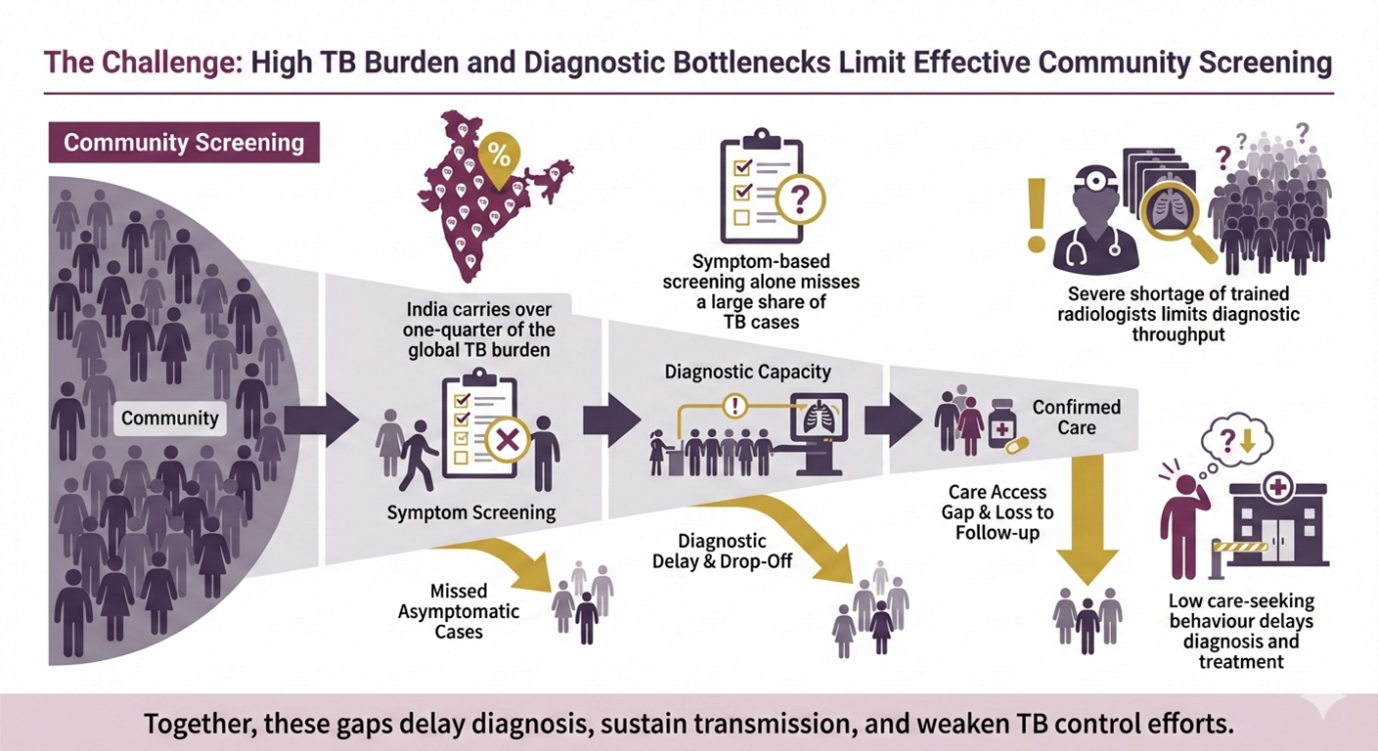
India bears 26% of the global TB burden, yet traditional symptom-based screening fails to detect a large proportion of cases. Limited availability of radiologists, poor care-seeking behaviour, and reliance on manual workflows constrained the effectiveness of community-based Active Case Finding, resulting in missed diagnoses and delayed treatment.
Solution
WJCF deployed an AI-enabled Express Health Camp model using ultraportable chest X-ray devices integrated with an offline-first Radiological Information System (RIS). The system enabled instant AI-driven interpretation, beneficiary data capture, and triage at the point of screening without reliance on internet connectivity allowing large-scale, efficient TB detection in low-resource settings.
Quick Facts

Organisation Name
The William J. Clinton Foundation (WJCF)

Organisation Website
Visit Site

Founding Year
2007, India

Number of Beneficiaries served
12,12,932 individuals screened

Geography Served
33 districts across 11 Indian states

Focus Area
Programmatic Impact

Functions Impacted
Program Delivery / Beneficiary Services, Technology & Data Management

Solution Provider
Developed In-house + Partners

Contact Email
msingh@wjcf.in
Full Case Study
Challenge
High TB burden and diagnostic bottlenecks limited the effectiveness of community-based screening.
Key systemic challenges included:
- High Disease Burden: India accounted for 26% of global TB cases in 2023.
- Ineffective Symptom Screening: 42.6% of TB confirmations would have been missed without chest X-rays.
- Severe Human Resource Gaps: Approximately 20,500 radiologists serve a population of 1.4 billion (~15 per million)
- Poor Care-Seeking Behaviour: 63% of individuals with chest symptoms did not seek care

Solution
Embedding real-time AI interpretation into frontline screening workflows.
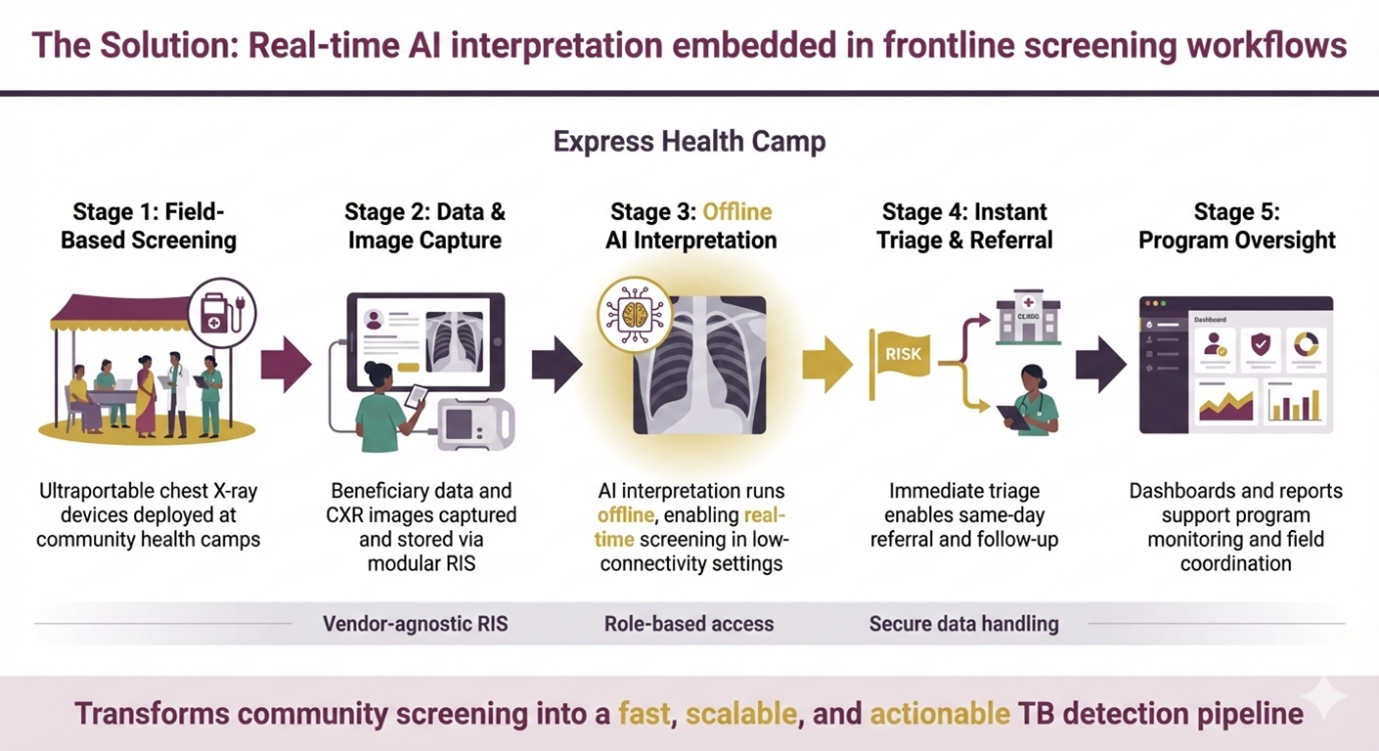
WJCF implemented AI-enabled ultraportable chest X-ray devices across Express Health Camps, integrated through a modular, vendor-agnostic Radiology Information System (RIS). The system captures beneficiary data, stores chest X-ray (CXR) images, runs AI interpretation offline, and generates dashboards and reports for program teams. Role-based access ensures smooth field operations, while instant triage enables immediate referral and follow-up.
Outcomes & Impact
Transforming TB screening efficiency and detection outcomes at scale.
- Deployed RIS across 72 machines nationwide
- Reduced screening time per beneficiary from 8–10 minutes to under 3 minutes
- Achieved a Number Needed to Screen (NNS) of 127 for one TB confirmation
- Detected 32% asymptomatic TB cases, often missed by symptom-based approaches
- Reduced average screening cost to approximately INR 1.5 per beneficiary
Technology Stack
| Name of the Tool | Where it was used | What it enabled | Category |
|---|---|---|---|
| Radiological Information System (RIS) | Express Health Camps | Offline data capture, AI integration, reporting | Proprietary |
| AI CXR Interpretation Models | Field screening | Instant triage of presumptive TB cases | Commercial |
| Ultraportable CXR Devices | Community screening | Point-of-care imaging | Commercial |
| Dashboards & Reporting Tools | Program management | Data-driven decision-making | Proprietary |
Key Project Learnings
- Offline-first systems enabled reliable screening in low-connectivity settings, directly increasing coverage
- AI-led triage reduced dependence on scarce radiologists, accelerating confirmations
- Integrating AI into routine workflows lowered costs while improving yield.
Potential for Wider Adaption
| Sector | Adaptability of the Solution |
|---|---|
| National TB Programs | Scalable deployment for Active Case Finding |
| State Health Departments | Integration into routine screening operations |
| Global Health Programs | Replicable model for high-burden, low-resource settings |
Additional Details
The information provided here is created as a community resource and is not intended as professional advice or a recommendation by ILSS or Koita Foundation. While we strive to ensure the accuracy of the content, we do not take responsibility for any errors or omissions. Users should use their own discretion before making any decisions based on this information. ILSS or Koita Foundation assume no liability for any actions taken based on the information provided.